


Smoky Off-Flavors in Cocoa Aren’t Caused Solely by Smoke
Researchers show: Overfermentation can also cause undesirable flavors
Freising, August 31, 2026 – Fermented cocoa occasionally exhibits off-flavors that can compromise the quality of chocolate and other cocoa products. But what causes these undesirable flavors? Researchers at the Leibniz Institute for Food Systems Biology at the Technical University of Munich have now shown that overfermentation of cocoa beans can cause smoky, leathery, and cheesy off-flavors. Smoky flavors, therefore, are not necessarily attributable to smoke contamination.
It has only been in the last few years that the odorants responsible for many cocoa off-flavors have been identified. However, how and under what conditions they arise is not yet fully understood. To get to the bottom of the causes, Franziska Krause and principal investigator Martin Steinhaus examined cocoa samples from various stages of fermentation and growing regions. Part of the work took place under real-world conditions on cocoa plantations in Nicaragua and Costa Rica, where Franziska Krause monitored the fermentation process on site.
Overfermentation promotes cheesy and smoky off-flavors
Using modern odorant analysis techniques in the laboratory, the researchers compared samples of optimally fermented cocoa beans with samples of intentionally overfermented beans. In doing so, they detected elevated concentrations of short-chain carboxylic acids in the overfermented samples. These compounds can cause off-flavors that smell like cheese, sweat, or vomit.
The overfermented samples also contained significantly higher concentrations of the compounds 2-methoxyphenol and 4-ethylphenol. Both substances have a smoky odor. While 2-methoxyphenol has a rather sweet, smoky smell, 4-ethylphenol also exhibits leathery, phenolic, and horse stable-like notes.
Better identifying and avoiding smoky off-flavors
In an earlier study, the research team had already identified and quantified off-flavor compounds typical of wood smoke contamination in cocoa beans. The new results now show that overfermented cocoa beans contain key smoke-like-smelling phenols in concentrations similar to those found in wood smoke-contaminated cocoa. “Our results thus demonstrate for the first time, objectively and at the molecular level, that smoky off-flavors can arise not only from smoke contamination but also from overfermentation,” says food chemist Martin Steinhaus.
Franziska Krause, a doctoral candidate at the Leibniz Institute, adds: “Another important finding of our study is that the quantitative spectra of the odor-active phenols differ between overfermented and wood-smoke-contaminated cocoa. These differences could help to identify the causes of smoky off-flavors more reliably in the future.”
However, the study not only provides new insights into the causes of off-flavors but also offers a practical approach to process control: At both study sites, the pH of the cocoa bean pulp in the fermentation mass increased significantly once the optimal fermentation duration was reached. A simple measurement using test strips could therefore complement the standard temperature, color, and odor checks, helping to detect the onset of overfermentation early on and prevent the development of off-flavors.
Despite differences in climatic conditions, cocoa varieties, and fermentation methods, the samples from Nicaragua and Costa Rica showed comparable results. The study thus provides important insights for the production of high-quality cocoa and for ensuring the sensory quality of cocoa products. Future research will now aim to clarify which microorganisms are involved in the formation of the identified compounds and at what concentrations these are actually perceived as off-flavors by consumers.
Publication: Franziska Krause, Martin Steinhaus; Off-Flavor Compounds in Fermented Cocoa: Impact of Overfermentation. J. Agric. Food Chem. July 29, 2026; 74 (29): 23069–23080. https://doi.org/10.1021/acs.jafc.6c05685
Funding:
This IGF project of the Research Association of the German Food Industry (FEI) was supported within the program for promoting the Industrial Collective Research (IGF) of the German Federal Ministry of Economic Affairs and Energy (BMWE) on the basis of a decision by the German Bundestag. Project No. 21290. N. Franziska Krause extends her sincere thanks for a doctoral scholarship from the Foundation of German Business (Stiftung der Deutschen Wirtschaft) with funds from the German Federal Ministry of Research, Technology and Space (BMFTR).
More Information:
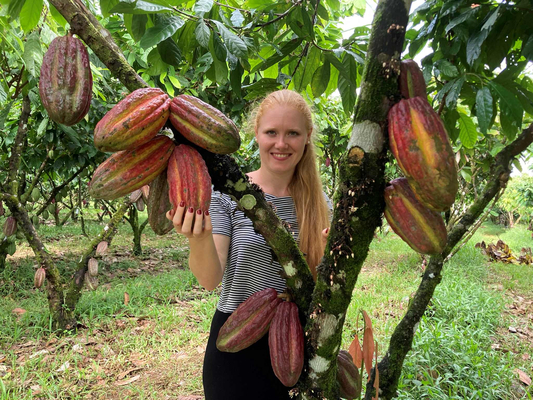
Cocoa processing is traditionally divided into two steps: In tropical regions, cocoa producers cultivate cocoa trees (Theobroma cacao L.), harvest the fruit, and extract, ferment, and dry the seeds, commonly known as cocoa beans. The cocoa beans are then processed into chocolate and other cocoa products, primarily in temperate regions. Today, the most important cocoa-growing regions are located in West Africa, Latin America, and Southeast Asia. Cocoa trees reach a height of 5 to 15 meters and bear their fruit on the trunk and large branches.
Read also: New markers for smoke flavor
An earlier study by Franziska Krause and Martin Steinhaus clearly shows that exposure to wood smoke during drying can cause a smoky off-flavor. This is primarily caused by 2-methoxyphenol, 4-methylphenol, and 3-ethylphenol. These compounds pass from the wood smoke into the cocoa beans and penetrate deep into the edible kernel—the cotyledons of the seed. This is crucial in practical terms, because even the subsequent removal of the shells does not significantly reduce the smoky off-flavor. In addition, the team identified 2,6-dimethoxyphenol as a marker for smoke exposure; however, this compound has little effect on the aroma.
Publication: Franziska Krause, Martin Steinhaus; Molecular Sensory Analysis Confirms Wood Smoke Exposure as a Source of Smoky Off-Flavors in Fermented Cocoa. J. Agric. Food Chem. August 6, 2025; 73 (31): 19663–19669. https://doi.org/10.1021/acs.jafc.5c06046
Reliably detecting cocoa off-flavors–Relevant not only for chocolate fans
https://www.leibniz-lsb.de/en/press-public-relations/translate-to-englisch-pressemitteilungen/pm-20210420-pressemitteilung-cocoa
Publication: Caterina Porcelli, Silva D. Neiens, Martin Steinhaus; Molecular Background of a Moldy-Musty Off-Flavor in Cocoa. J. Agric. Food Chem. April 21, 2021; 69 (15): 4501–4508. https://doi.org/10.1021/acs.jafc.1c00564
Publication: Daniela Füllemann, Martin Steinhaus; Characterization of Odorants Causing Smoky Off-Flavors in Cocoa. J. Agric. Food Chem. September 30, 2020; 68 (39): 10833–10841. https://doi.org/10.1021/acs.jafc.0c04633
Contacts:
Expert Contact:
PD Dr. Martin Steinhaus
Head of the Aroma Chemistry research group
Leibniz Institute for Food Systems Biology
at the Technical University of Munich (Leibniz-LSB@TUM)
Lise-Meitner-Str. 34
85354 Freising
Tel.: +49 8161 71-2991
Email: m.steinhaus.leibniz-lsb(at)tum.de
Press Contact at Leibniz-LSB@TUM:
Dr. Gisela Olias
Knowledge Transfer, Press and Public Relations
Tel.: +49 8161 71-2980
Email: g.olias.leibniz-lsb(at)tum.de
www.leibniz-lsb.de
Information About the Institute:
The Leibniz Institute for Food Systems Biology at the Technical University of Munich (Leibniz-LSB@TUM) comprises a unique research profile at the interface of Food Chemistry & Biology, Chemosensors & Technology, and Bioinformatics & Machine Learning. As this profile has grown far beyond the previous core discipline of classical food chemistry, the Institute spearheads the development of a food systems biology. Its aim is to develop new approaches for the sustainable production of sufficient quantities of food whose biologically active effector molecule profiles are geared to health and nutritional needs, but also to the sensory preferences of consumers. To do so, the Institute explores the complex networks of sensorically relevant effector molecules along the entire food production chain with a focus on making their effects systemically understandable and predictable in the long term.
A Member of the Leibniz Associatation
The Leibniz-LSB@TUM is a member of the Leibniz Association, which connects 96 independent research institutions. Their orientation ranges from the natural sciences, engineering and environmental sciences through economics, spatial and social sciences to the humanities. Leibniz Institutes address issues of social, economic and ecological relevance.They conduct basic and applied research, including in the interdisciplinary Leibniz Research Alliances, maintain scientific infrastructure, and provide research-based services. The Leibniz Association identifies focus areas for knowledge transfer, particularly with the Leibniz research museums. It advises and informs policymakers, science, industry and the general public.
Leibniz institutions collaborate intensively with universities – including in the form of Leibniz ScienceCampi – as well as with industry and other partners at home and abroad. They are subject to a transparent, independent evaluation procedure. Because of their importance for the country as a whole, the Leibniz Association Institutes are funded jointly by Germany’s central and regional governments. The Leibniz Institutes employ around 21,400 people, including 12,200 researchers. The financial volume amounts to 2,3 billion euros.
Note on the use of AI
The press release was first translated from German into American English using DeepL Pro. The researchers then reviewed the text, making corrections where necessary to ensure it was both factually and linguistically accurate.
+++ Stay up to date via our LinkedIn channel +++