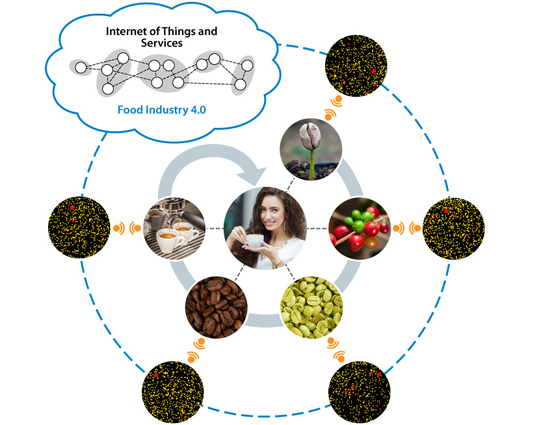
1. Predictive Food Effector Systems
The selection of plant and animal raw materials already has a significant influence on food quality. Not only the genotype or variety, but also (a)biotic stress factors and the soil microbiome already have an influence on the composition of the raw materials (effector profiles) and thus on food quality. During the processing of plant and animal raw materials into final food products, their constituent systems undergo complex cascades of (bio)chemical transformations. Leibniz-LSB@TUM is researching these functional effector systems (active systems) with the help of state-of-the-art omics technologies (genomics, transcriptomics, proteomics, metabolomics, sensomics) and mathematical and computer-based methods of machine learning and modeling at the molecular level (recording – assessment – prediction) in order to better understand and predict their development along the entire value chain (“from farm to flush”).
Using bioinformatics-based methods, Leibniz-LSB@TUM optimizes the functional effector systems that significantly influence individual preferences (with a focus on aroma, taste, texture/mouthfeel) and acceptance (especially food intolerances) as well as the nutritional value (primarily immune stimulation) of foods.
Research activities include in particular:
- Elucidation of the structure-dose-function relationships of complex patterns of techno-functional and biologically relevant effector systems in food and in the human organism, including raw materials and side streams from food production (including precursor characterization).
- Investigating the influence of external environmental factors on effector systems.
- Elucidating the transformation of relevant effector systems from raw materials to final food products.
- Generation of understanding and prediction of functional effector systems in food and the human organism for the adjustment of individual preferences, acceptance, and physiological needs, utilizing the potential of new breeding forms, alternative raw materials, process side streams, and new production and processing technologies.
- Creation of a molecular basis for the adaptive production of personalized foods and to ensure the traceability and auditability of food quality, safety, and authenticity (Food Industry 4.0).